What your wallet gets wrong about Avalanche fees
Avalanche C-Chain no longer prices gas like Ethereum. What a week of live measurement shows about the base fee, the tip and the RPC that reports them.
On Monday 9 November 2026, news that the New York Stock Exchange had picked Avalanche technology for the settlement layer of its planned tokenized stock platform sent AVAX up as much as 10% [1]. NYSE will run its own chain, not the public C-Chain, but C-Chain traffic jumped anyway. Between 12:00 and 16:00 UTC, as AVAX rose from $8.26 to $8.91 on the Chainlink price feed, mean block fullness went from about 2% to 5%, peaking at 13% over ten minutes, and the base fee went from 2.5 gwei to 53.7 gwei.
That night, with no announcement, validators raised the fee floor. Between 23:40 UTC on 9 November and 05:14 on 10 November it went from 2.5 gwei to 7.5 gwei.
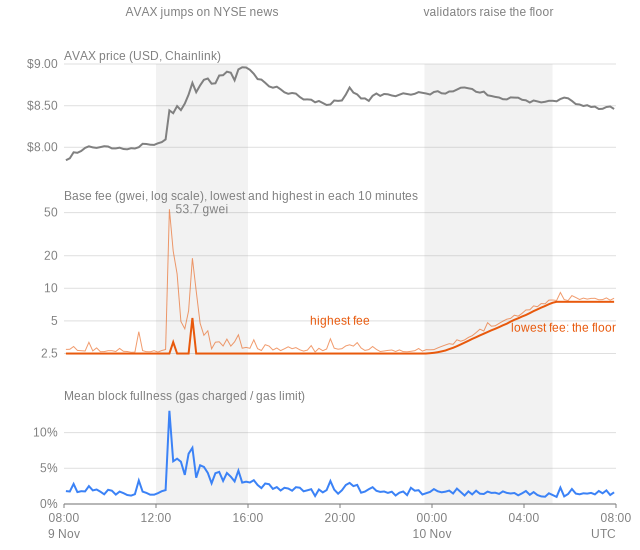
Since 22 September, C-Chain no longer prices gas the way Ethereum does. The upgrade that switched on Streaming Asynchronous Execution (SAE) [2] replaced EIP-1559's base fee with a gas clock and a floor that validators vote on, and most wallets still treat the chain as if nothing changed. I built gasometer to measure what a transaction actually needs to pay, and ran it against mainnet. Its first week shows wallet defaults landing a transaction within 2 seconds about half the time, a hard-coded floor going wrong by a factor of three overnight, and an RPC field that holds two different numbers.
What a week of measurement shows
gasometer runs four predictors once a minute on each network it watches, each bidding for a plain transfer to land within 2, 30 and 120 seconds, and scores every bid against the cheapest bid that would have landed [3]:
marketbids the median tip of the latest block: what senders are paying.nodebids the node's suggested tip,eth_maxPriorityFeePerGas, with a max fee of the next base fee plus that tip.walletbids the same tip with a max fee of twice the next base fee, as ethers [4] and web3.js [5] do by default.gasometerbids the 0.99 quantile of recent blocks' cheapest included tip.
Over the week of 4 to 11 November 2026 on C-Chain, gasometer was the only predictor that landed 99% of its bids within two seconds:
| Within 2 s | Landed | Overpaid |
|---|---|---|
market |
84.31% | 53.1% |
node |
52.49% | 0.0% |
wallet |
54.11% | 0.0% |
gasometer |
99.06% | 35.9% |
Bidding the market's median tip landed less often and overpaid more. The node's 150 wei suggestion never overpaid, because it is the cheapest tip any block includes, but only 29.8% of blocks include a tip that low, so it missed about half the time. Blocks are 1.8% full on average, so a block's cheapest tip is set by whichever few transactions it happened to hold. Landing 99% of the time means covering the blocks that happened to hold expensive ones, and that is where gasometer's 35.9% goes.
Given 30 seconds, every predictor lands, and the difference is cost:
| Within 30 s | Landed | Overpaid |
|---|---|---|
market |
99.71% | 51.1% |
node |
99.12% | 0.4% |
wallet |
99.95% | 0.5% |
gasometer |
99.92% | 0.5% |
A bid at the market's median tip paid about twice what landed. The node's suggestion and gasometer's bid both came within half a percent of the cheapest fee that would have landed.
The max fee matters only when the base fee moves. While the floor rose on 10 November, 81% of node's 30 and 120 second bids landed, capped at the next base fee plus the tip, while wallet, with twice the next base fee, landed 99.7% to 100%.
Most of the time the base fee does not move, because it sits on the floor. On every day from 28 October to 12 November, apart from the 10th, 77% to 94% of blocks were priced within 1% of it [6]. There are short bursts every day, but the longest run of blocks more than 1% above the floor lasted 45 minutes. 9 November was the busiest day in the data, with 23% of its blocks above.
One caveat applies to every overpay figure here. Each bid is scored against an upper bound on the tip a block needed, so the overpay is a lower bound. Figures from real transactions are in progress. The live numbers are on the public dashboard [7].
The last finding is about the RPC. Through the public endpoint, reading the latest block and then asking eth_feeHistory for the next base fee returned a different number from eth_baseFee in 40 of 199 samples, about one time in five.
Why: how SAE prices gas
The full working, with every claim traced to avalanchego's source [8], is in the reference write-up [6]. The short version follows.
The gas clock
SAE separates agreeing on a block from executing it. Consensus fixes which transactions run and in what order, and an executor on every node drains the accepted blocks from a queue. The catch is that a builder no longer knows how much gas the blocks ahead of it will use, which is exactly what EIP-1559 needs to set the next base fee.
So SAE prices on time instead. The chain sustains a fixed rate of gas per second [9], so gas measures time: a block's gas tells every node how long it takes to execute, without anyone trusting a wall clock. A gas clock tracks an excess , which rises when blocks use more than the target and drains when the wall catches up, and the price is
where is the minimum gas price and is a scaling constant set to 87 times the target. The builder prices the worst case: it assumes every transaction uses its full gas limit, so the base fee in a block header is an upper bound on what the block will actually charge. To stop anyone inflating that worst case for free, SAE charges every transaction at least half its gas limit.
A full block is 10 seconds of gas, and each one raises the fee by
so a burst of full blocks raises the fee 12.2% a block. Under sustained full blocks the fee doubles every
and once demand stops, idle time halves it at the same rate, until it reaches the floor.
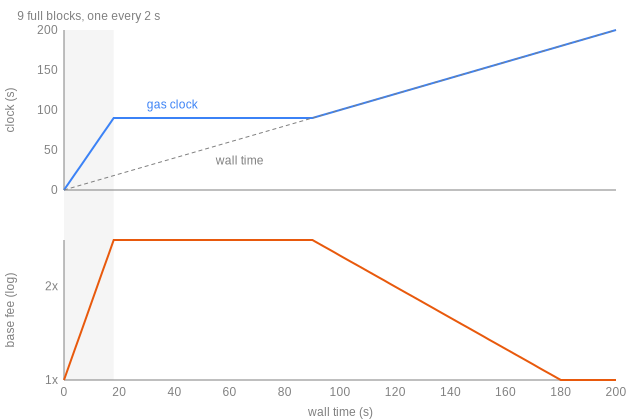
Nine full blocks, one every 2 seconds, put the gas clock 90 seconds ahead of the wall in 18 seconds and lift the fee to about 2.8 times where it started. It stays there until the wall catches up, and only then does idle time bring it down. That is the 9 November spike: a few hours of fuller blocks, and a fee that fell back to the floor once they stopped.
The floor is a vote
Halving every idle minute would take the price towards 1 wei, and at near-zero prices on-chain spam stayed profitable and kept blocks full of junk. ACP-283 [10] made the minimum a validator vote instead: each validator configures the price it wants, and each block's builder moves it a small step towards its own preference.
The floor moves slowly by design: each block may move it by at most a 3,600th of a doubling, so at one block a second it can at most double or halve in an hour. The 10 November rise ran at about 1.25 times an hour. At that period's block rate the protocol allowed 1.92 times an hour, so tripling could have taken 1.7 hours. It took 5.6. I found no announcement explaining the change, and nothing ties it to the news.
Two different next base fees
eth_baseFee returns the last accepted block's worst-case bound. The last element of eth_feeHistory is that same bound only if the newest block asked about is the last one the answering node has accepted. Otherwise it is the header fee of the block after it. Behind a load balancer, a client reads the latest block from one node and asks another for fee history up to it, and the second node has often accepted the next block already. In all 40 of the mismatched samples, it had. At the floor the two numbers can be equal, but they are different quantities.
What a wallet should do
- Bid on
eth_baseFee, not on the last entry ofeth_feeHistory.eth_baseFeealways returns the same thing: the last accepted block's worst-case bound. The fee a block actually charges is never higher than that bound, so a max fee set from it cannot be outbid by the base fee in the next block. - Keep the gas limit within twice the gas you expect to use. SAE charges at least half the limit, so padding an estimate by more than 100% is money spent.
- Read the floor rather than remembering it. While demand stays below the target, the base fee is the validators' minimum and only the tip is left to overpay. A configuration that said C-Chain costs 2.5 gwei on 9 November was wrong by a factor of three by the next morning, and nothing announced it.
References
[1] O. Dale, "Avalanche (AVAX) Price Jumps 8% as NYSE Confirms 24/7 Tokenized Stock Settlement Plan," CoinCentral, Nov. 10, 2026. [Online]. Available: https://coincentral.com/avalanche-avax-price-jumps-8-as-nyse-confirms-24-7-tokenized-stock-settlement-plan (accessed Nov. 13, 2026).
[2] A. Schlosberg and S. Buttolph, "ACP-194: Continuous Execution," Avalanche Community Proposals. [Online]. Available: https://github.com/avalanche-foundation/ACPs/tree/main/ACPs/194-continuous-execution (accessed Nov. 12, 2026).
[3] B. Wolfaardt, "gasometer's first clean week," gasometer, 2026. [Online]. Available: https://github.com/BenWolfaardt/gasometer/blob/ca40f869ec2255ed264de3ec389a027bfbb1877b/docs/first-week.md (accessed Nov. 12, 2026).
[4] ethers.js, "src.ts/providers/abstract-provider.ts, v6.17.0," GitHub. [Online]. Available: https://github.com/ethers-io/ethers.js/blob/v6.17.0/src.ts/providers/abstract-provider.ts#L992 (accessed Nov. 12, 2026).
[5] web3.js, "packages/web3-eth/src/utils/get_transaction_gas_pricing.ts, web3-eth 4.11.1," GitHub. [Online]. Available: https://github.com/web3/web3.js/blob/bf1691765bd9d4b0f7a4479e915207707d69226d/packages/web3-eth/src/utils/get_transaction_gas_pricing.ts#L69 (accessed Nov. 12, 2026).
[6] B. Wolfaardt, "How the C-Chain base fee works under SAE," gasometer, 2026. [Online]. Available: https://github.com/BenWolfaardt/gasometer/blob/ca40f869ec2255ed264de3ec389a027bfbb1877b/docs/sae-gas-pricing.md (accessed Nov. 12, 2026).
[7] B. Wolfaardt, "gasometer," Grafana. [Online]. Available: https://ionsie.grafana.net/public-dashboards/f7aee50b6bb34f9e92f94ec700509cf8 (accessed Nov. 12, 2026).
[8] Ava Labs, "avalanchego v1.15.2, vms/saevm," GitHub. [Online]. Available: https://github.com/ava-labs/avalanchego/tree/v1.15.2/vms/saevm (accessed Nov. 12, 2026).
[9] S. Buttolph and M. Kaplan, "ACP-176: Dynamic EVM Gas Limits and Price Discovery Updates," Avalanche Community Proposals. [Online]. Available: https://github.com/avalanche-foundation/ACPs/tree/main/ACPs/176-dynamic-evm-gas-limit-and-price-discovery-updates (accessed Nov. 12, 2026).
[10] S. Buttolph and M. Eckardt, "ACP-283: Dynamic Minimum Gas Price," Avalanche Community Proposals. [Online]. Available: https://github.com/avalanche-foundation/ACPs/tree/main/ACPs/283-dynamic-minimum-gas-price (accessed Nov. 12, 2026).